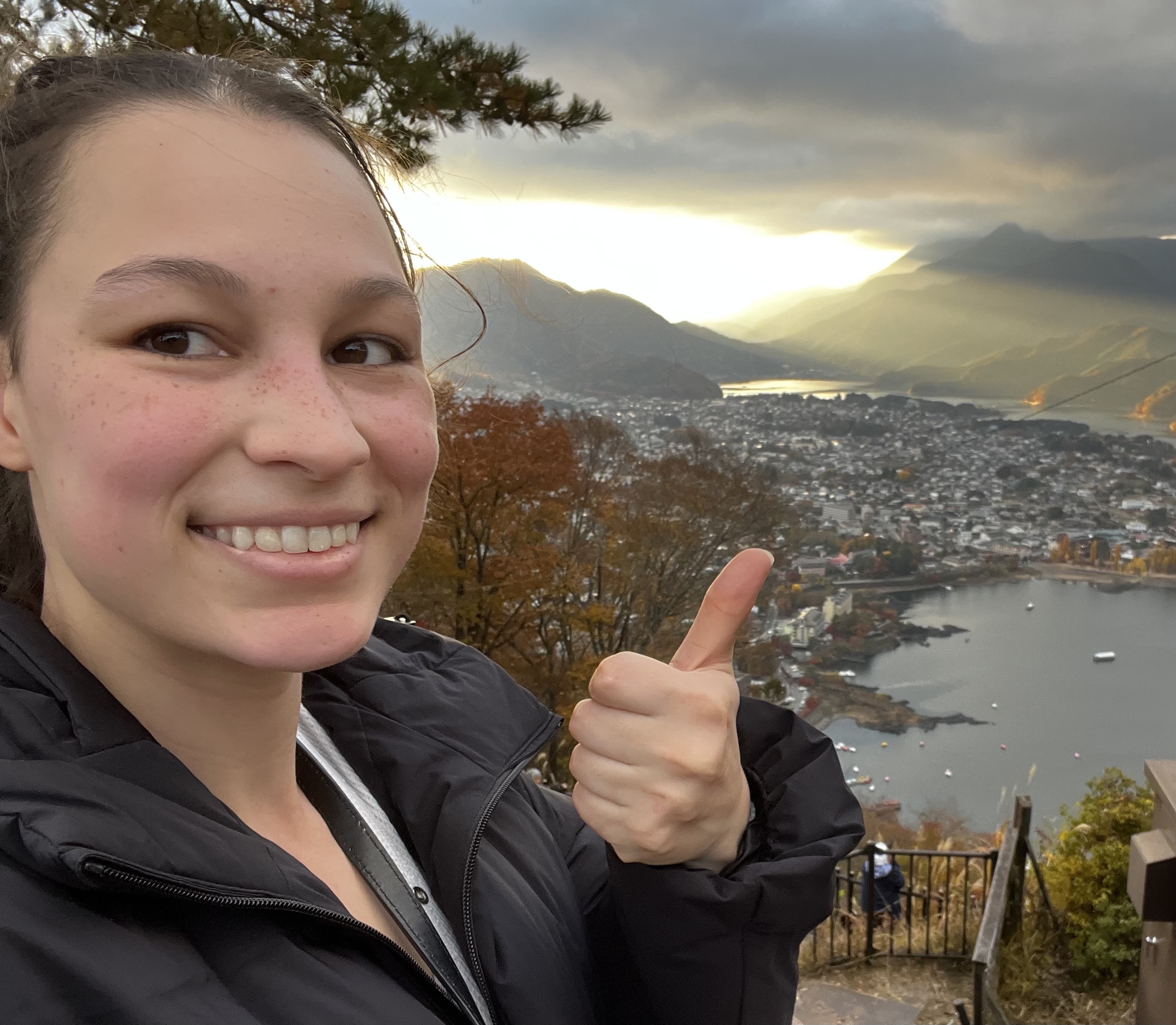
Economics major Alexa Halliwell spent Fall Quarter studying abroad in Tokyo at Hitotsubashi University. Drawn to the program after exploring the UW Economics study abroad options, Alexa was motivated by both academic rigor and the opportunity to experience economics outside a U.S.-centered framework. “Studying in Japan would let me apply the skills I developed in school and travel to Asia for the first time. It seemed like an amazing opportunity,” she shared. As a senior, the ability to earn advanced economics credit while studying internationally made the experience especially compelling.
At Hitotsubashi, Alexa completed six economics courses across two quarters, many taught at the 400-level, including International Trade, Comparative Development, Econometrics, Behavioral Economics, Environmental Economics, and Economic History of Japan. She noted that studying economics abroad made the discipline feel more immersive and immediate. “I could observe firsthand the ripple effects of Japan’s rapidly depreciating currency on trade, tourism, and everyday costs,” she explained. Being outside the Western news bubble also allowed her to engage in nuanced discussions about fiscal policy, immigration, and governance with local residents, an experience that brought macroeconomic concepts into daily life.
Alexa’s coursework also allowed her to directly connect economic theory with institutional realities. For a research project in her comparative development class, she examined Japan’s paid time off policies, finding that “despite formal PTO mandates, workers rarely used leave because informal social norms penalized absence and rewarded visible commitment.” Drawing on economists such as Douglass North and Oliver Williamson, she observed how informal institutions and governance structures can be more influential than formal legislation. These insights, shaped by both academic research and lived experience, deepened her understanding of how economic systems operate beyond textbooks.
Reflecting on her time abroad, Alexa emphasized how studying economics internationally strengthened her research, technical, and analytical skills. Hitotsubashi’s curriculum, she noted, emphasized “creative and independent thinking,” with extensive opportunities for long-form research, presentations, and coding in R and LaTeX. She also praised the UW Economics study abroad process, sharing that “I didn’t feel confused about how my courses would transfer and the department is always responsive to questions.”